Friday, November 13, 2009
A Cancerous Man with a Plan
Diane and he both agreed that I should restart the Keflex antibiotic to stop the smell coming from the recent fistulas (ulcers) on my neck skin,"Et Voila!" the smell is gone the next day!
Now every time a Dr. looks at my fistulas he gives us the "Carotid Blowout" scenario, very seriously, we cut them off saying Dr. Harrison gave us this speech before even starting the neck skin radiation. It's an odd telling though, for the docs explain very somberly how the opening fistula could reveal the Carotid artery and then the Carotid could open - leading to the "blowout" (see it in the summer blockbuster "Carotid Blowout!!".) Then he goes on to the plusses, where how it is painless, happens in a couple of minutes and all I would notice is my getting tired, and going to sleep for a long long time. Its the up-beat moment - like a get out of jail free card! Actually, it sounds a lot easier that way than languishing in bed, besotted with opiates, half-dreaming of naked female pirates at battle with the neo-cons for clothes at JCPenney!
There is no treatment for these fistulas, just keep them dry and avoid hitting them with your golf club.
So we picked up plans and news today and we both felt is was a great day! How was yours?
Tuesday, November 10, 2009
Progress with a kink!
The cats are not behaving well - Poe wants to go outside all the time since the weather is so nice, according to him even in the middle of the night, and Emily refuses to adjust to the time change - insisting instead on falling further back by an hour and asking for dinner at 4! Mere distractions!
Monday, September 28, 2009
Troubled Waters
Today we saw my medical oncologist (chemo) and the plan is to start steroids tomorrow to see if they help the swelling and to also start one of the new bio-drugs, Tarceva, a kinease inhibitor, which is designed to block cell tumor cell growth by targeting the protein called the Human Epidermal Growth Factor Receptor. Along with that, we will restart the Gemzar that I was on before as it did have a slowing effect on the cancer. I like this plan of attack.
Even better though is the conversation we had with the Beth Israel social worker, Darren Arthur, who not only knows the ins and outs of the system to try to get home health care for me, but also helps me identify and understand the source of my anxiety. (3 major sources: abandonment - my birth mother abandoned me and my brother when I was 2 and Diane's return to school after a whole summer off has triggered that; second I am dealing with the first illness in my life that I can't manage a "work around" as I always have; third I am very social and the swelling has really put a damper on my old habits, especially of talking with people, and directing plays, and such) So I feel that I can start to deal with these issues now that I have an understanding of where they come from. Much better than just saying as I did in the first paragraph (that I wrote this morning) I am powerless to deal with them. Don't you think?
Oh! and I forgot to mention that I have gained 4 lbs in the past week. Still 3 pounds short of where I should be for a minimum but it is great that Diane's shakes and our determination to get back to a fighting weight is starting to work.
So while this has been a good day, or more accurately a definite swing in the right direction, I can't sign off with my usual "Yep, it's a great day!" just yet! Though as I write, both Poe (the ginger) and Whitman (the grey short hair feral-come-adopted us) cats are at the bottom of the bed! Good boys!
"Yep, it's a good day!"
Friday, September 25, 2009
Downs and Ups
We went to see my surgeon to find out about the bleeding and the white fungal type stuff in my trachea's stoma (the hole in my throat.) The news was quite simple - the disease has progressed and the white area is disease with perhaps an superficial infection, and the bleeding was coming from more disease at the back of my mouth & nasal passages.
While this may sound terrible, it was good to know what was going on.
The surgeon suggested I have a "peg" (feeding tube) put in to avoid using my mouth for food. i decided that I didn't want another surgery now and would add the weight orally.
The remarkable thing is that once we'd made the decision and emailed my palliative care doctor about the weakness and depression, we felt we could make a plan with his help.
Add weight with a concerted diet of Carnation Instant Breakfast Very High Calorie cans (560 cal each) mixed with peanut butter, oil, and ice cream. Start taking a stimulant, Ritalin, to make me feel stronger, more energetic, and increase my appetite. And approach my chemo Dr to go back onto chemo to slow the disease again.
Remarkably the next day I was stronger, had a 2700 calorie day, and felt like the extreme depression (almost suicidal) was lifted! Perhaps it was just the little pill - or maybe it's my natural state and I needed help getting there - but my mental transformation is so remarkable that I can hardly believe the thoughts I was having before.
My palliative care doctor, Stewart Fleischman, pointed out that cancer can do that. It can both sap your strength and medicinally create depression.
But it feels great to be back fighting!
Oh! And here's a great little discovery from last night: I can use my wedding ring t
o open my left eye! i take it and put in right over where my pupil is, which holds the swollen eyelids back allowing me to see out of two eyes at once!! I'll try to find rings that work even better that I can put in both eyes. It may look odd but from inside it makes the world so much brighter!Of course, I have to tell you that our ginger cat, Poe, was very attentive throughout this whole episode. If I was on the bed, he'd be there. If I was on the couch, he'd be above me on the pillow, and he silently followed me around for several days. Very sweet! So again I say to you " Yes, it's a great day!"
Friday, August 28, 2009
Tips For Survival
What a rush!! For almost a day I was famous thanks to all the great comments on the NYTimes.com essay : When Cancer Changes Your Appearance. I was humbled by the response, and filled with joy at the thought that my story helped others. Thank you.
One friend suggested I share my patient experience with those for whom illness and/or the medical system are relatively new and consequently monumental. There is a lot that I could waffle on about, but I’ll try to keep it usably concise.
The diagnosis: the doctor tells you that you are actually quite sick. Alarm bells go off in your head, your emotions trigger an instant need for oxygen or a run to the bathroom, and if you were asked what 2 + 2 equals you’d probably say, “milk!” As the doctor continues to talk, your otherwise together self dissolves into an emotional mess. So take a friend, spouse, relative with you to act as your support and to take notes. My wife Diane has done that for me throughout my medical mishaps - her notes and sense have proved invaluable.
Next stage: you’ve got the problem - how do you solve it? You feel like you are facing Mount Everest with one crampon and a goat. You want the best advice possible, but where is it? There are so many ways to find information. Burying your head in the sand isn’t one – this is where and when you start preparing for the fight to come. I suggest you ‘network’ your way to the best solution. Email and/or call all your contacts and ask if anyone knows anyone who has had your condition. Ask all your doctors whom they might recommend. Once you’ve got a few names, look them up on line – or get a friend to – to learn more about them.
Beth Israel (BI) Med Center’s Head and Neck Center for Cancer has treated me for 4 years. I found them because the wife of a fellow Master’s program graduate worked at Cancer Care (www.cancercare.org a great resource for all kinds of cancer information.) Her boss was the wife of the head of BI’s program. So through them, I called him. It was an encouraging conversation. I verified the excellence of BI’s Head & Neck cancer treatment by talking with several independent oncologists. I met with Dr. Persky, an oncologist there, and was again reassured of the high quality of their service. My original diagnosis had been done at NY Presbyterian Hospital, however their program wasn’t cohesive enough to meet my needs. I also discarded my other choice, Memorial Sloane Kettering, for their tendency at the time to treat patients like numbers, which I got from patients who were currently being treated there and I am definitely not a patient who tolerates that style of treatment.
Treatment: Like preparation – research your options. Get second opinions before you plunge ahead. Your insurance company should allow this and doctors encourage it. You shouldn’t feel that you are betraying your current doctor by “going behind his back” for another opinion. Either you will find a difference of opinion, giving you cause for further preparation, or you will be reassured that you are on the right course.
Tips during treatment:
- Have your medical history prepared and ready. Yesterday we were behind a woman who had just handed in pretreatment forms that she thought she’d filled out correctly. The receptionist said nicely, ”no dear, you’ve got to fill out this, …and this, …and this top part only, and all of this page, then you must sign and date here, here and here, OK?” as she flipped through what resembled the next Harry Potter novel. The woman’s jaw just dropped, it was deer in the headlights time for her. In order to cut through much of what she was facing, I suggest you summarize your medical history in a short form. (You can take a look at my medical history form as an example. It should include the dates of injuries, diagnosis, surgeries, the hospital of doctor involved; plus a summary of your current conditions; a list of your medications; and a list of your doctors with their contact numbers. This will help more than you can imagine when you go to a new doctor, go for a scan, or go for surgery etc. Just submit this with the forms they give you and scrawl (with glee) “see attached” on their forms.
- Always take something to pass the time – a book or iPod is my preference. You will run into delays everywhere in the medical system, especially in the emergency rooms!
- If you get nervous about tests, let your doctor know and be clear about it. It made a big difference when my doctor gave me a prescription for Atavan (or the generic Lorazepam) the anti-anxiety drug. I am claustrophobic so I always take one before PET/CT scans and MRI’s as the machines are very close.
Insurance issues: when you get your diagnosis, call up your insurance company to find out how they deal with your problem.
- Are you going to have to get referrals to every doctor (usually ‘’yes” with any HMO.)
- How can you see someone who’s “Out of Network?” This is not impossible, but you will have to convince the insurance company that this doctor is unique in his ability to deal with your problem and that they don’t already have such a specialist on their list of approved doctors. The specialist you want to see will usually help you try to win this argument.My kidney and pancreas transplant was “Out of Network” in Pittsburgh, PA. I petitioned beforehand with Oxford and succeeded to gain approval.
- Also one doctor at at center may not take your insurance (Dr. Persky didn’t take mine) but another at that center may (Dr. Sessions did.) So keep pressing until you are satisfied.
- Try to pay your co-pays at the doctor’s office the day you visit. The way some insurance companies present bills for co-pays can be very confusing, and they are often wrong. So try to keep your records sorted, the paperwork you might receive could be overwhelming if you don’t.
- If you get a denial for coverage from an insurance company: fight it!! Like a parking ticket in NYC. Insurance companies lean towards using “denied” often, and often on wrong information.Call the insurance company, if you don’t understand something on your statement. They can be very helpful in explaining, and can often correct mistakes they’ve made over the phone.
She also recommends you talk to your anesthesiologist before the surgery to ask her or him to literally whisper sweet, positive images as you go under and the same again as you come out. I love the conversation I have with them just before surgery – “Doctor as you knock me out and also as you bring me back, could you please describe Cape Cod sand dunes, and the wind and sea, saying how good this surgery will be, and how well I will recover afterwards at the same time?” Usually the anesthesiologist pauses, “…uh?” and I get the surgeon, who likely as not has already heard me ask this before, to pitch in on my behalf. It’s fun to spin it out a bit! But I swear it works!! In the past 10 years I’ve had about a dozen surgeries, 3 which lasted over 10 hours and one of which was 17 ½ hours and my recovery is always remarkable and, oddly, with very little pain.
In hospital: Be as nice as possible to everyone, absolutely everyone. The nurses work extremely hard and are the center for everything that happens in your room. They all have names, it helps if you get to know them and use them. Diane, God bless her, stays with me all the time, sleeping over in the reclining chair or, if we are lucky to find one, a cot. She helps by getting clean linens and making the bed etc. Just as with the “cable guy” in my early post, the nurses love the help and we get great attention when it is really needed. Diane’s staying with me helps me recover quicker too.
In hospital too: check your meds! Despite their best intentions, the doctors and nurses can mess up your meds, especially if you’re already taking some prior to admittance.
That’s all I can think of for the moment. To be a successful patient you have to be determined to beat your problem and to do it with a laugh and a smile on your face! So have a great day! Yep, because it is a great day!
Sunday, August 9, 2009
"I Am A Doctor!"
Apparently he believed he was the “Cable Doctor,” and he also thought I would spit on him and infect him with my disease. He wasn’t the most charming of people. When Diane opened the front door at the top of the stoop in answer to his knocking on the gate under the stoop, he barked: “why does it say basement?” (On the Time Warner Cable account – who knows?!) Then he said, “You don’t have dogs!?” She reassured him we didn't and he entered, only to be confronted by a stooped, swollen headed, man who breathed through a hole in his neck and was dressed like a samurai on holiday. To further his unease, I started talking to him – apologizing for my terrible diction and unintelligible voice (an unfortunate and unintended result of my cancer.) When he responded, “ why doesn’t she interpret?” I naturally started to don my ‘kill the technician’ armor, preparing for a loud but unintelligible assault on the jerk.
Diane realized that I was about to sink our chances of ever again receiving my daily salve, the BBC America channel, and hastily cautioned me that “now wasn’t the time.” I disagreed and by nods of the head and hand gestures we commenced to argue, which luckily I lost. Diane talked with the tech, listening to his fear of contagion, fear of my spitting on him, and correcting him about my medical condition and my ability to spit. The contrite tech then confessed that two of his close relatives had died from cancer and apologized to both of us. I accepted his apology instead of lopping of his head and, of course Diane was right, and he redoubled his efforts at perfecting our service going above and beyond.
How does one deal with someone whose appearance has changed from the dashingly handsome, ok I’m taking some poetic license, to totally disfigured and, one might say, grotesque. We’ve been trained by movies and TV to worship perfection. After all the bad guy is always either bald, short, limps, is missing an eye, scarred or has some other abnormality to distinguish him from ‘us’ the perfect audience. My close friend recently told me he was “shocked, I tell you, shocked,” by my appearance when he saw me again after 6 months. I’m shocked sometimes too.
It’s as much a learning curve for me as for others. I am not sure how people will take me: whether I’d make them uncomfortable, whether they would be able to overlook the changes and look for the person who still inhabits this misshapen head. I have to talk myself into going out now. A little pep talk reassures me that, whatever others may think, I must not quit without trying. My difficult speech has similarly influenced my choices – I tend not to answer the phone and am now a listener in group settings, only lobbing in a few bon mots every so often, and then re-lobbing them until people understand. My timing is truly unique. To combat the verbal steamrollering of members of my family I raise my hand before speaking. Quite humiliating, sort of, but very effective!
What do I want people to do? I want everyone to feel comfortable around my appearance. Don’t worry that you have to address my illness in a compassionate way, or at all. Just say what you want when you want. I’ll let you know if you offend, or if I need something. What I enjoy most is watching others enjoy themselves. My friend Steve said “well, you’ve got that portly Asian look down now,” and that was nice, funny and quite off the cuff. It made me feel that I could relax and not worry that the conversation was going to slide into the Grand Canyon of medical awkwardness. My neighbor’s 3-year-old daughter treats me just like everyone else, someone to flirt with! So if you see a slightly hobbled, melon headed, man wearing a hat, walking with a stick towards you just say, “hi, it’s a great day! Isn’t it?” And I’ll say, “yep, it’s a great day!” and feel it too.
Tuesday, July 7, 2009
Bowel Me Over
There is unsettling about the oncology nurse’s inquisition when it goes from “are you in pain?”, (of course, and it’s either from the cancer or the treatment!) to “when did you last go to the bathroom?” The question seems out of place, a brain fart almost. But, without batting an eye, you answer “yesterday,” or “three weeks, two days and five hours ago,” and groan.
Suppositories, enemas both water and mineral oil, Senna tablets, Docusil, Milk-of-Magnesia (where is ‘Magnesia’?), magnesium citrate are the OTC (over the counter) remedies and it’s up to you to find the right balance. But sometimes another drug or treatment conspires with the pain meds to ambush your best defenses, and then you get an impacted bowel, as I did a few weeks ago. I’d rather call it a painfully immovable, over-stuffed sausage angrily meditating above your groin.
Admittedly, we were slow to ask the right person for the OTC cure so we threw suppositories and water enemas up there like shoppers at a Prada sale. I consumed the oral options too but the angry Buddha had shut down my entire gastric system, so they came back rather quickly. The answer turned out to be mineral oil enemas. Days later I was back chirping with Jamie Lee.
Of course anyone with half a brain is asking themselves, “why didn’t he speak to a gastroenterologist?” Well I tried. First my old GI didn’t take my insurance anymore and I hadn’t developed the sort of doctor – patient relationship with him that enabled a quick email or call (more on the vital importance of this in another post.) So then I asked both my primary doctor and my Chemo doctor, both of whom recommended a visit to the emergency room if it continued – a very expensive option that vacuums time like nothing else in the world. So I set about getting an appointment with a new GI.
Visiting a new specialist doctor, in New York City at least, is like landing on an orbiting planet – you have to wait for months for an opening. Call after call resulted in, “are you a current patient? No? He can see you just before hell freezes” or words to that effect. Frustrated, I emailed my oncologist for help. A week later I was sitting in the GI’s waiting room and since my crisis had ‘passed’, I was there for a general plumbing check.
In walked nattily dressed Doctor X carrying my freshly minted chart. He asked for my problem. I put my speaking valve on my tracheotomy and explained, in my difficult to understand voice, what had happened. As I was talking, he was reading my chart - this unnerves me because it’s like driving and talking on the cell phone, you don’t have undivided attention. He read my Medical History (written and printed at home, it’s an invaluable one page, medical summary that includes a medication list - saving a great deal of time with doctors’ and hospitals’ forms.) He expertly prodded my belly, announced I no longer had the impaction, and prescribed a drug and a colonoscopy, saying, “my assistant will arrange that with you for next week.” I didn’t bother with a peevish “I told you already it was gone,” but did reminded him that I get nausea for a week after each chemo dose, so it might be better for me to try to chug the reservoir of liquid required during my week off. Then he was out the door.
This all sounds proper. BUT, and this is my biggest concern with doctors today, I never really had his attention. He said all the right things but didn’t respond to the individual variations of my case. Later I found the medication doubled my chemo’s nausea and it wasn’t necessary since I was no longer impacted by the impaction. This sort of half-wittedness may just be the result of insurance income pressure. Many doctors today leave 15 minutes per patient or less, to keep up the frequency of reimbursements or just because they want to serve as many as possible. But that is not the doctor for my colonoscopy.
Here ends the blog on bowels and consternation. Thanks for reading and have a great day…after all the cats are happy with this great weather!
“I am Sir Brian, as bold as a lion!
Take that! – and that! – and that!”
Thursday, June 25, 2009
Introduction to My Health
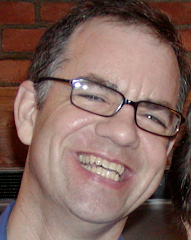
All mine: 3 kidney transplants, a pancreas transplant, 27 years of type 1 diabetes, 4 plus years of metastasizing cancer, a broken leg, elbow, wrist, both feet, hands, skull and ribs (yes I might be accident prone from time to time,) plus all the secondary illnesses that waltz along with these problems (osteoporosis, Gastroparesis, cataracts, chronic facial swelling (also known as moon face - see photo,) gall bladder failure, impacted bowel, chronic bleeding, etc...)
I have survived over 40 years of ill health. Sickness does not dominate my life. And okay, this is about my health, but it is also about yours. I have learned to live a life of chronic patienthood where I am not dominated by illness. I have managed to focus on goals that have nothing to do with illness. Living life for me is learning to surf above the uneven terrain of my health.
I had chemo Tuesday. Again. I’ve lost track of the months I’ve been on, but I started 7 drugs and two years ago after two years of surgery and radiation. And it IS a drag! So, to divert myself from the on-coming nausea and tiredness, I started this blog today.
I hope this blog will help others who are living with chronic illness, to laugh. Also, if you are already a friend, this will keep you updated on my health. Most, my wish is to help other patients realize hope and gain knowledge through shared experiences. (No one wants to, or should have to, deal with chronic illness on their own.)
Today’s word: GEMCITABINE, my current chemo drug. Don't ask me to say it, please. Pronouncing it would be difficult for an intact person and, as it is, I have only half a functioning tongue. 2 weeks on and one week off. Side effects: nausea, puffy skin, and fatigue. And fatigue. It seems to slow down the cancer, (metastasized squamous cell carcinoma that started in my rear tongue and spread to my lymph nodes and then (now) to the sub layers of my skin on my neck and chest. It hasn't stopped me.
I get up each morning and remind myself that I’m going to be swollen, tired and nauseous. So if I get something done, like epoxy the hatches of the kayak I’m building, it’s a great day!! Or if I get through all my (liquid) food, it’s a great day! Or if one of our cats comes up to say hello, rub itself on my leg and settle down for a nap near me…yep: great day!
Today is a great day! Thanks for reading.